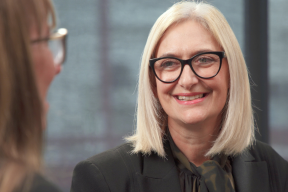
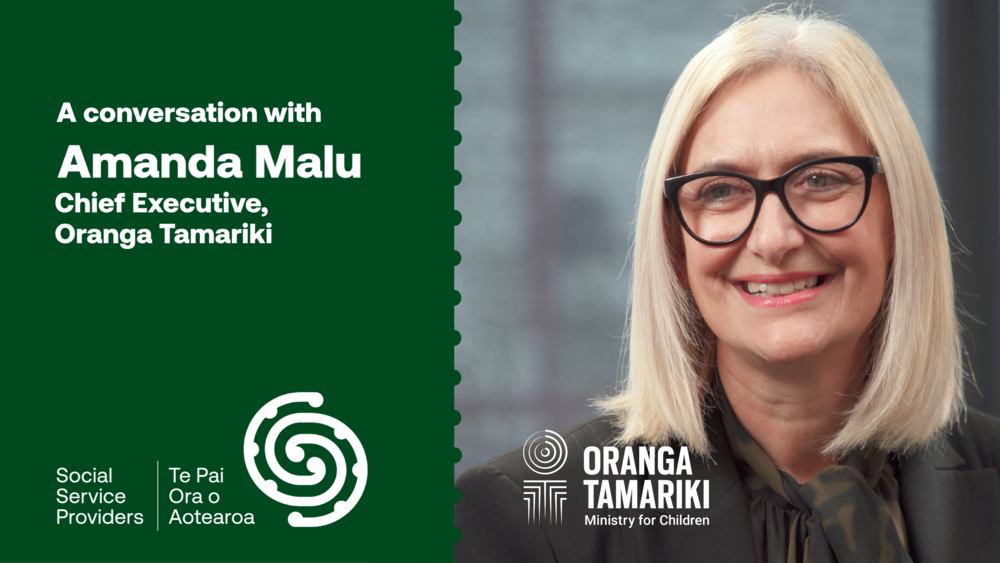
Introducing Amanda Malu
Kia ora, Amanda. It's wonderful to have this opportunity to sit down and have a bit of a discussion. It's been eight weeks. How's it going?
I can't believe it's only eight weeks, it feels like I’ve been here much longer. It has definitely been a steep learning curve. It's one thing to think you know what it's going to be like when you apply for a role and you come into an organisation and another to get in it, especially an organisation as large and complex as this one. But it has been terrific. People are very patient with me. I'm slowly getting my head around all of the complexity and the breadth of what we do, and so far so good. I’m really loving it.
What was it that attracted you to apply for the role?
It's fair to describe this as a dream job and people might think that's a bit strange. But for eight years, I worked at Whānau Awhina Plunkett and six of those as Chief Executive. So, I was on the NGO side of health and social services. The thing that I found really frustrating was seeing where change needed to happen and not really being able to effectively influence. That was when I started to think, well, maybe I'm going to have to get closer to government to see if I can make a difference and make some improvements. So that was probably the big reason for applying. Also, I just think this organisation does such incredible and really important work, and I feel really privileged to be a part of it.
Often the work of Oranga Tamariki is seen as being the ambulance at the bottom of the cliff. How do you see all your range of experiences helping to lift the experience of the children?
I think I bring probably a slightly eclectic range of experiences. I've spent a lot of my career working in education and a little bit of health, obviously. some in social services and social development. And they all kind of come together in a really interesting way to kind of best prepare me for this role.
I think describing Oranga Tamariki as the ambulance at the bottom of the cliff is right, but also we do a lot of work before to keep children out of the Oranga Tamariki system. That’s a lot of the work and that’s invisible. People don't see it. They don't understand it. And that's huge success for us when we're able to work with a whānau and keep their child in that family and safe. So, I think there's a bit of both. But the work is incredibly important. It's challenging for our staff, but they do an incredible job. I see that every day when they go out onto sites.
I think it's wonderful that you've talked a bit about the early intervention work, because a lot of our sector, that's where the real passion is, is helping at the earliest possible point. How do you imagine the relationship with community and how we can work together on those common areas of interest?
It's just completely codependent, isn't it, that relationship? We can't do what we do without the incredible support of community providers. And I think you're right, you know, we do rely heavily on the work community providers do in the prevention and early intervention space. For me, that's an important part of the system that we're in. I really value that work. You know, I was a part of it, you know, as a universal service at Plunkett. So, you know, you've got a huge advocate in me for that work. I think it's an incredibly important relationship that we need to make sure is strong.
As a wahine Māori what particular strengths do you bring into this landscape and relationships or ways you might operate?
I do come from a line of very strong women in my family, wāhine Maori. But also, I have a lot of empathy for people who are finding their way into Te Ao Māori. You know, I didn't grow up steeped in Māoritanga. It's really, as an adult, that I've kind of really more strongly connected with that side of me. I know from many about tamariki and rangatahi, they're in the same situation so I can bring an element of understanding to their situation. Primarily, I think people would say, I have a level of tenacity about me and I'm up for a challenge and certainly like to meld collaboration, imagination, curiosity in everything that I do and those that I work with.
What are your thoughts about your vision for now and what you want to see in five years?
I think right now, probably my priorities are really fully understanding the organisation and the sector sufficiently so that I can really add value… And longer term, we've just got to do the absolute best for children in our care and so we need to deliver the care standards. We need to ensure that our staff are really well supported to do the great work that they do every day. I have been absolutely blown away by the passion of this organisation and the incredible work our team does every day. And so for me, success in five years looks very much like a really enabled workforce that feels really well supported by the organisation, that feel empowered to do the great work that they do, has great tools, has great support from colleagues, and that will play out in the experiences of our young people and our caregivers and community providers that work with us.
What makes you laugh out loud? How do you step away from the intensity of the role?
So pretty much I'm spending a lot more time thinking about work than I probably ever have. And I think that's just the nature of this role and where I am in my time here. I have a daughter who's a stand-up comedian, so that helps… It’s just a a good way just to forget about whatever might be worrying me. I'm a pretty average golfer, but I give it a go, more so to see my husband, who is a much more avid golfer than me, but it's a good way to get out and walk.
Is there anything you'd like to say to the community sector?
Well, I'd certainly like to say a huge thank you. I know it's not easy work … but it's so rewarding. I see the same passion in community providers that I see in Oranga Tamariki staff, and we all want the same outcomes. It’s been great to understand how important those relationships are and that … it's more than a funder-provider relationship. It has to be a partnership. I'm just really grateful for the great work that communities and community providers do every day on our behalf and on for their communities.
This is an edited excerpt from the transcript.